🤖 Artificial Intelligence changes companies before it changes organizational charts
In recent years, the most common question about artificial intelligence has been: “Will AI replace humans?”
The reality, however, is different.
Transformation does not begin with layoffs or spectacular reorganizations. It starts much more subtly: by changing the way people work, collaborate, and make decisions. And this change is already happening in thousands of companies around the world.
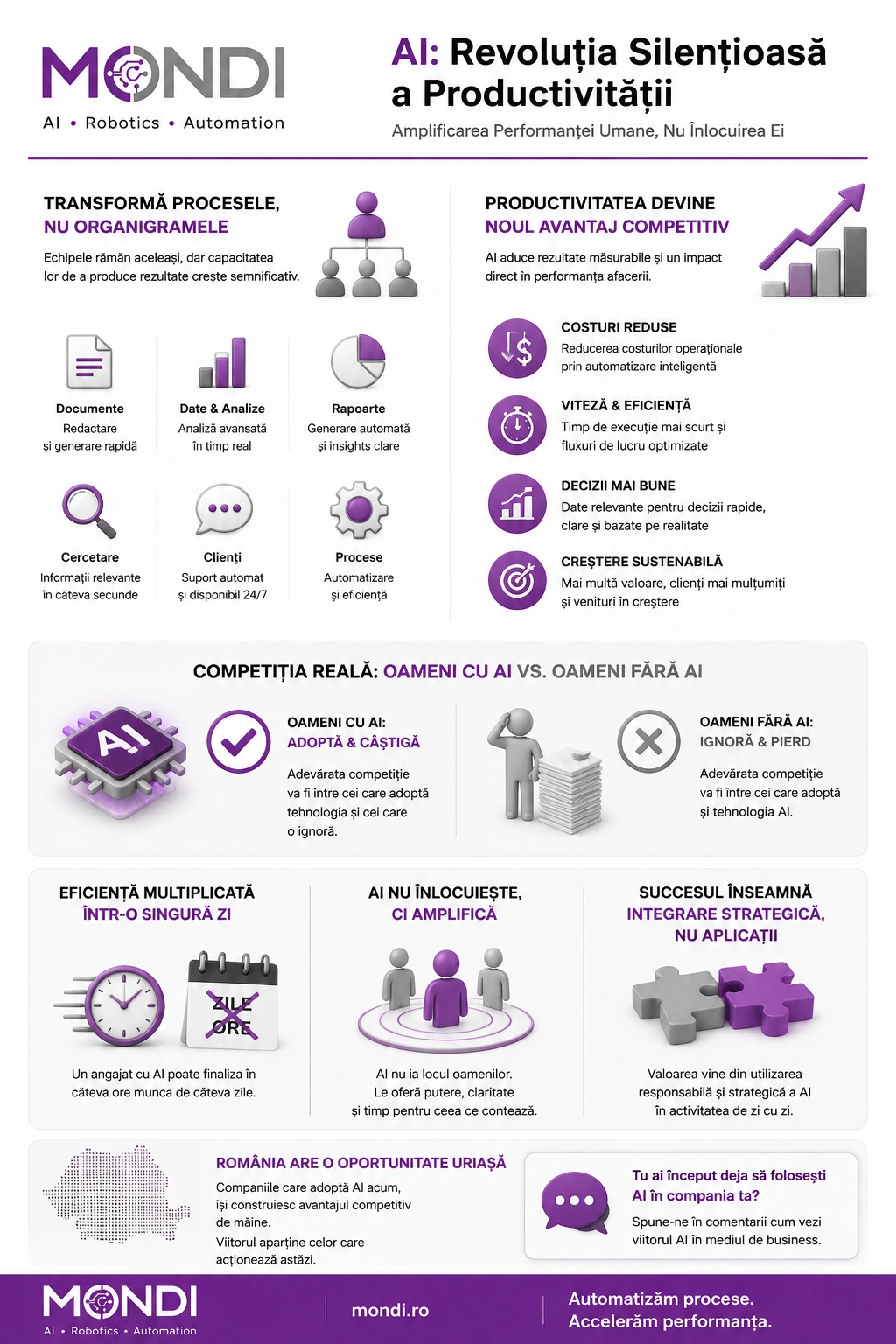
🚀 AI changes processes, not just technology
Many organizations today have the same organizational chart as they did two or three years ago.
There are still managers, specialists, sales, marketing, HR, or finance teams.
The difference is that the same teams can produce significantly more using artificial intelligence.
Today, AI can contribute to:
✅ drafting documents and commercial offers
✅ rapid analysis of large volumes of data
✅ generating automated reports
✅ market research and competitive analysis
✅ customer support automation
✅ optimization of repetitive processes
The result is simple: less time wasted and more time dedicated to value-added activities.
📈 Productivity becomes the new competitive advantage
Companies do not invest in AI just because it is a trendy technology.
The goal is much more pragmatic:
💰 reducing operational costs
⚡ increasing execution speed
📊 data-driven decisions, not assumptions
🎯 improving service quality
📈 business growth without proportionally increasing the number of employees
Organizations that intelligently adopt AI manage to do more with the same resources.
👨💼 AI does not replace people. It makes them more efficient.
One of the biggest fears is that artificial intelligence will eliminate jobs.
In reality, in most cases, AI does not replace people, but helps them become more efficient.
An employee who knows how to use AI tools can accomplish in one day what previously took several days of work.
The real difference will not be between people and AI.
It will be between people who use AI and those who choose not to.
🏢 Leaders need to understand AI
Digital transformation is no longer the exclusive responsibility of the IT department.
Managers and business leaders need to understand:
🔹 where AI can add value
🔹 which processes can be automated
🔹 what risks need to be managed
🔹 how it can be implemented responsibly in the organization
Success will not belong to the companies that use the most AI applications, but to those that strategically integrate them into their daily activities.
Romania has a huge opportunity
More and more Romanian companies are starting to experiment with artificial intelligence-based solutions.
Although the pace is still different from that in Western markets, the advantage is that companies can learn from the experience of those who have already begun this transformation.
Those who adopt AI today are building a competitive advantage for the coming years.
🔮 Conclusion
Artificial intelligence does not just change a company's technology.
It changes the way people work, communicate, make decisions, and create value.
Organizational charts may remain the same for a while.
However, processes, skills, and ways of working are already transforming, and this change will redefine the success of organizations in the next decade.
💡 Have you already started using artificial intelligence in your company or are you still analyzing the opportunities? Let us know in the comments how you see the future of AI in the business environment.