The Reality of Artificial Intelligence Adoption
What are the main barriers preventing organizations from deriving value from AI?.
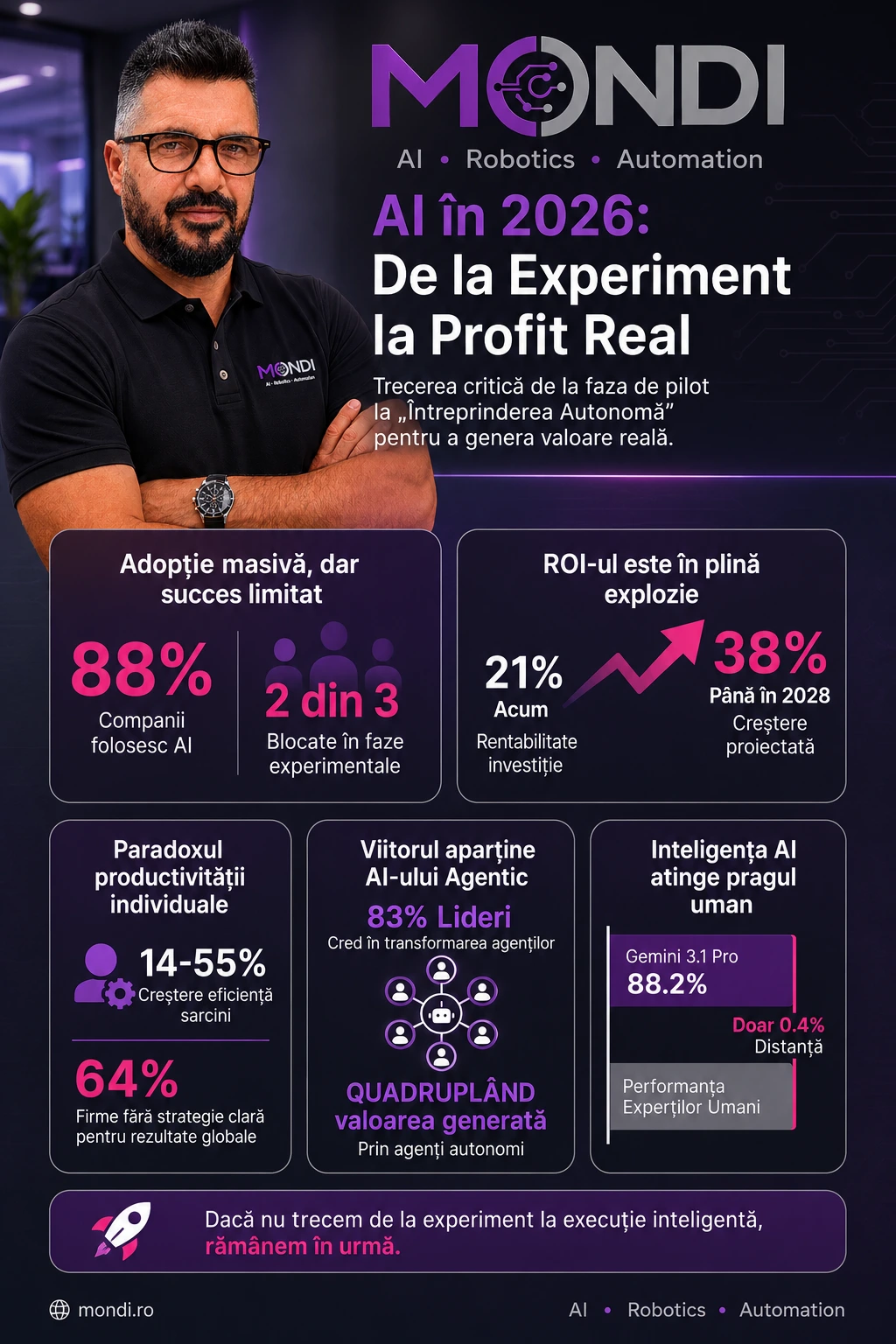
Although 88% of organizations are already using artificial intelligence, only 6% manage to achieve real value from it, the rest being stuck in experimental phases. Sources identify a complex set of structural, technical, and human barriers that prevent the transformation of investments into measurable business outcomes. The main identified barriers are:
1. Lack of strategy and difficulty measuring ROI
- Absence of a clear direction: Approximately 64% of companies cannot clearly define what they want to achieve through AI, using technology without well-established objectives and priorities.
- “The Productivity Paradox”: Although AI generates increases of 14-55% at the individual task level, these do not always translate into profitability at the organizational level (EBIT) because processes are not fully rethought.
- Justificarea investiției: 56% of directors (CEOs) report that they still do not see a measurable ROI, which leads to the abandonment of projects after the prototyping phase.
2. Skills deficit and resistance to change
- Lack of internal expertise: The lack of employee skills is considered the biggest barrier to integrating AI into existing workflows. Many organizations focus only on basic training, neglecting advanced implementation and governance skills.
- The human factor: About 45% of employees show resistance to change, and 64% fear that AI could take their jobs, which slows down adoption.
- Lack of job redesign: 84% of companies have not redesigned roles and processes around AI capabilities, limiting themselves to using new tools on old structures.
3. Data quality and readiness
- Incomplete or fragmented data: 73% of organizations report that they are not data-ready, facing unclean data, information silos, and a lack of a “single source of truth.”
- Poor infrastructure: Many companies, especially in manufacturing, ignore the need for massive investments in data infrastructure (data pipelines, connectivity) before they can implement AI models.
4. The “Pilot Purgatory” and integration issues
- Scaling failure: A major barrier is the gap between the success of a pilot project (conducted under controlled conditions) and production implementation, which requires integration with legacy systems, security reviews, and continuous monitoring.
- Integration crisis: 58% of organizations are facing a platform integration crisis, with workflows remaining fragmented and dependent on manual intervention.
5. Governance, security, and regulations
- Security risks: Data privacy concerns (73%) and cybersecurity are critical barriers, especially in regulated sectors like financial services.
- Delayed governance: Only 12% of companies believe they have the necessary processes and frameworks to govern AI effectively. Often, governance is treated as a post-implementation administrative checkbox, not as a foundation.
- Legal complexity: Regulations like the EU AI Act add layers of complexity and compliance costs, which can discourage rapid adoption if not integrated from the design phase.
Schedule a free process audit now.
Transform processes into profit with AI
Do not implement AI before you know where it produces the most value. Schedule a 1-on-1 meeting for a process audit and identify opportunities for automation, optimization, and cost reduction.